Sunday, May 16, 2010

April 26

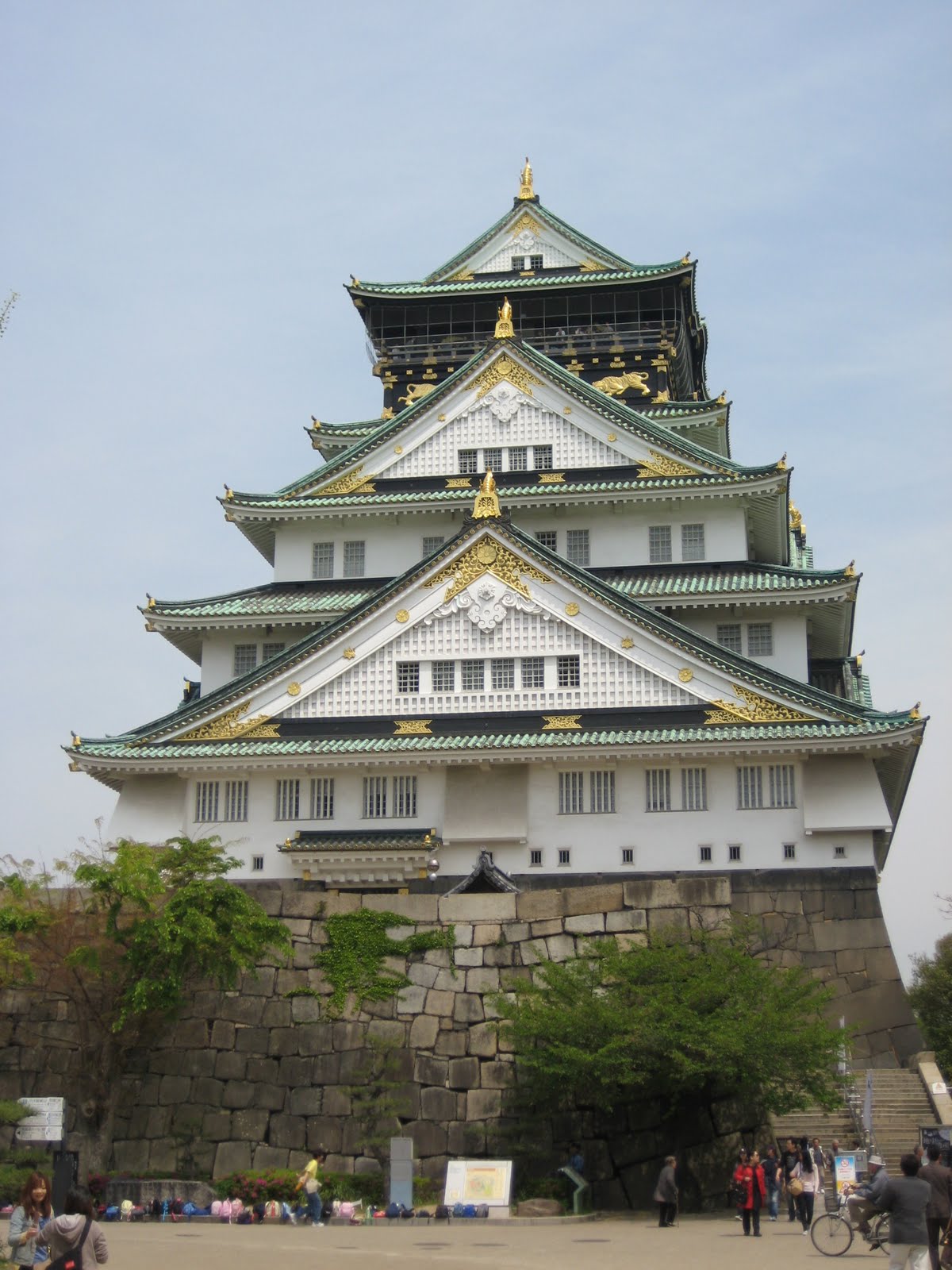
On Monday morning, we visited Osaka Castle. In contrast with Matsumoto Castle, which had been well preserved, the main tower of Osaka Castle has been reconstructed multiple times, and now has a modern museum inside, with elevators and all. The museum taught me about Toyotomi Hideyoshi, who was born as a peasant and ended up conquering all of Japan. One of his conquests was accomplished by diverting a river to flood a castle that was in a plain below sea level.


After having lunch at the castle, we got our bags and took the bullet train back to Tokyo. Going back to Tokyo felt a little like coming home, especially since we spent our last two nights at the same hotel we started at.

April 24

So we're obviously way behind on this blog, having been home for a while now. Lexi has decided that I should finish the last few days since she wasn't feeling well at the time, and doesn't remember them too well. And we have to finish it because we have a special treat for anyone who follows it all the way to the end.

Anyway, we started off Saturday by going to the Osaka Human Rights Museum. The train that my iPod told us to take was a bit off the beaten path. In fact, the train station we got off at was the only station we saw that was entirely unmanned:


But of course it turned out that there was a much better, and less scary-looking way to get there.

The museum deals with issues of discrimination against various groups of people in Japan. These included Koreans, Okinawans (indigenous people of the islands south of mainland Japan), the Ainu (indigenous people living in Hokkaido), the Burakumin, victims of Minamata disease, women, and the disabled. Probably the most interesting of these groups to us was the Burakumin, who were outcasts at the bottom of the caste system of the Edo period. They were considered contaminated by death in their professions, being butchers, leather workers, grave diggers, etc. Even today, their descendants face some degree of discrimination and stigma.

After the museum, we went to Amerikamura, which is an area full of hip used clothing stores and hip youngsters sporting interesting fashions. It supposedly got its name from shops selling goods imported from America.

Friday, May 7, 2010

April 23

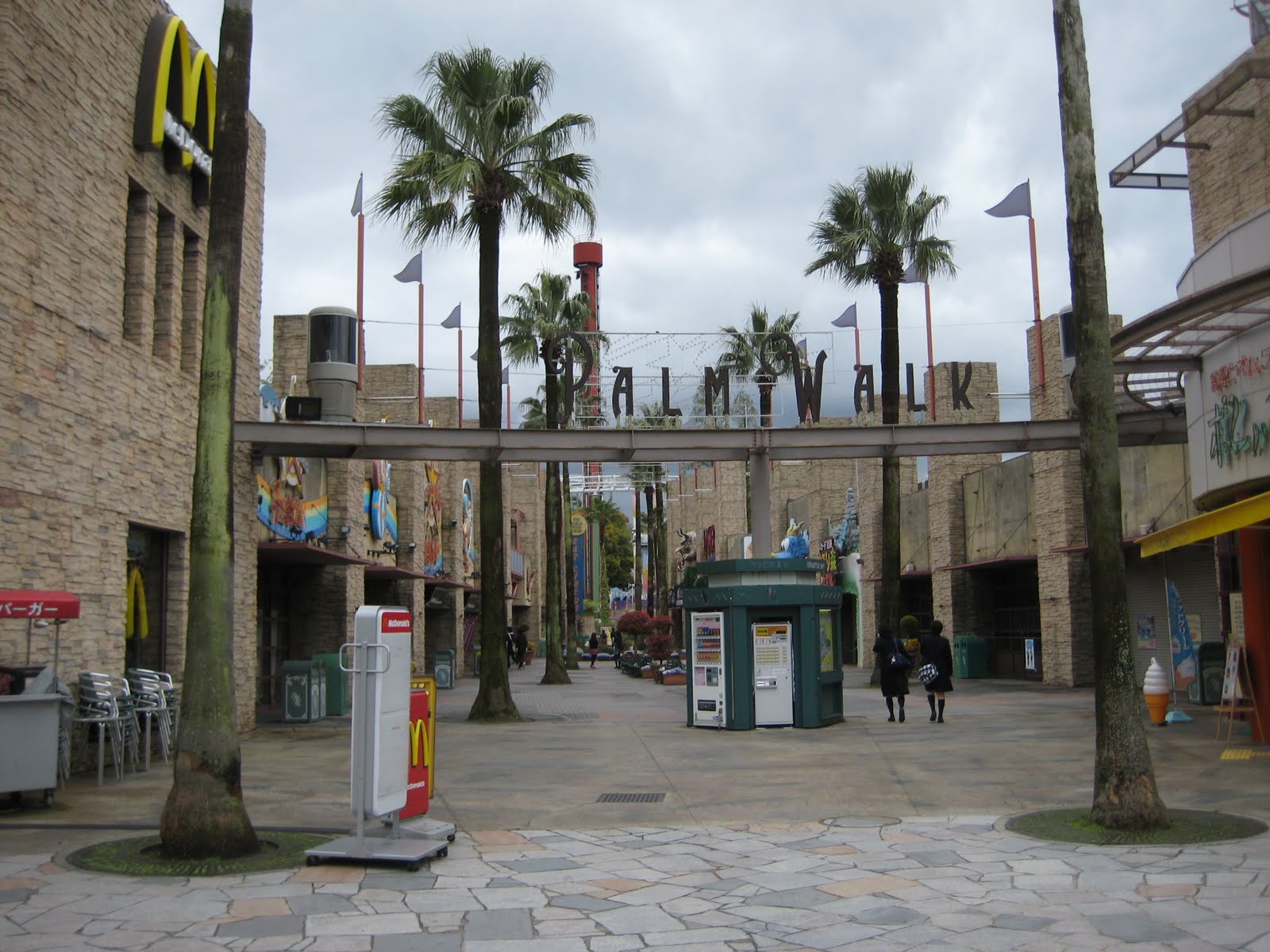
The next morning, we went out to Hirakata Park, which is a local amusement park just outside of Osaka. The good thing was that it was a little sprinkly outside, so we were pretty much the only people in the park. The downside was that the roller coasters weren't too exciting... fortunately there was a bunch of other really random stuff there too.


There were these funny guys all over the park... we couldn't figure out who they were supposed to be, but they were pretty rad:


Strangely enough, they had 3 different zoo animals there kind of intermixed with the rides. These lesser pandas were really cute!


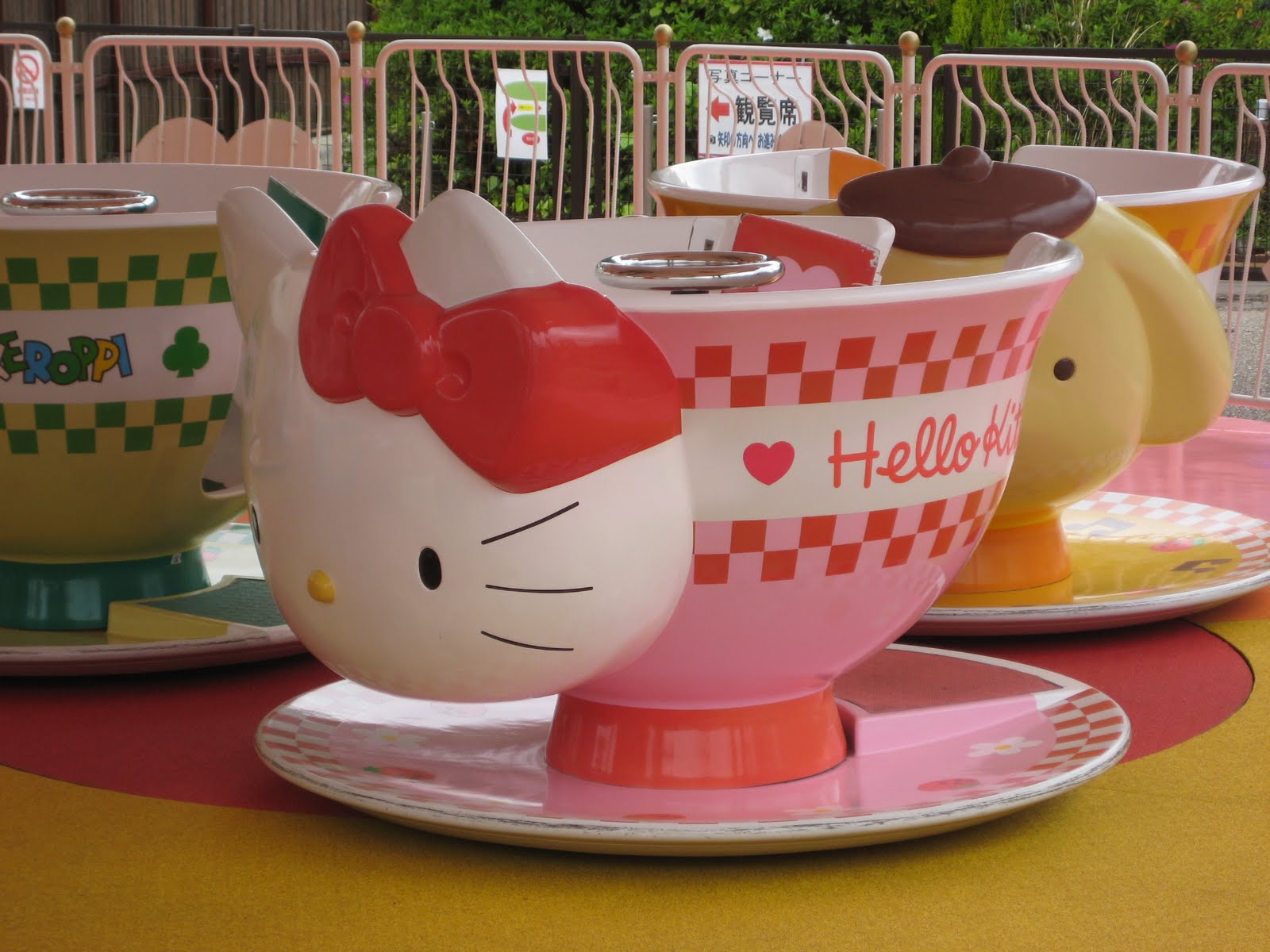
They also had this super cute rip off of Disneyland's teacups.


True to most places in Japan that we'd been, they had at least 2 different arcades with quite unique video games. This one was an arm wrestling game:


This was a very... um... interesting ride. It never seemed to have anyone on it, and the guy operating the ride would stand atop is ride tower looking forlornedly out across the park, hoping someone would come and ride his ride. Seeing that there was no line, Erik and I tried it out... we found out the reason that no one was riding it. You have to PEDAL. That's right, YOU propel the coaster. It was low on the thrill scale, and high on the discomfort scale, but it was certainly unique... this little girl seemed to be getting a kick out of it, but I think that little boy is doing all the pedaling for her


They had a ferris wheel there as well, and although I don't like ferris wheels (especially after my previous experience), Erik convinced me to go so that he could get some good pictures. I was rewarded with this guy:


And Erik was rewarded with a pretty nice view:


Finally, the had a little section called "Hug Hug Town" where you could go in and pet all sorts of different animals, including dogs and cats! Now, I was on serious Selphie withdrawl by this point, and desperately wanted to cuddle some animals. Sadly, Erik didn't want to go in because it was stinky. I told him it was just the smell of farm (they had llamas and ducks and stuff like that in there too), but he still wouldn't let me go in *sob*.

We spent the evening at a place called "Spa World." It is basically an onsen turned amusment park. It's about 7 floors filled with different spas, relaxation and beauty services, and restauarants. The onsens were themed: the womens baths were Asian themed and had baths decorated in the style of "Islam", Japan, Persia, Bali, as well as several onsen with special additives with medicinal effects. The mens onsen were European: Roman, Mediterranean, Greek, Finnish, Italian, Spanish and "Atlantis." I obviously couldn't take any pictures within the onsen itself, but the website has some pretty cool pictures of the onsen:

Let me tell you, they need NEED to have something like this in the US. A few hours of soaking and I felt like I could do ANYTHING. After a nap.

Thursday, May 6, 2010

April 22

Thursday started out as a bit of a bummer because it was raining... again. This time it was raining quite hard, and it didn't take long for the water to seep all the way through our shoes and socks. We attempted to go to the Shitenno-ji temple, one of the oldest Buddhist temples in Japan. It seems that every time we changed cities, our lost meandering began again, and by the time we realized we were there, I was too cold to really enjoy myself, or to let Erik enjoy himself. There were also supposed to be some ceremonial dances going on that day, but I guess they must have been cancelled due to the rain. We got some snapshots and bolted.


Intensely craving something warm to eat and a place to take our soaking shoes off, we wandered into a Chinese food place at the train station. Now, we couldn't read most of the menus in Japan, but for the most part we'd gotten along ok by either the assistance of semi-English-speaking waiters, pointing at a picture menu, or gesturing at the food models outside. This had worked pretty well for us to this point... however, the unfortunate thing about Chinese food is that a lot of it is kind of chunky things in a sauce. It is difficult to determine what said chunky things are from say, a picture, because much of their physical characteristics are obscured by the yummy sauce. When the plate of food comes out, however, you may find that what you thought was beef in the picture is actually...liver. And what you thought was chicken or pork in the picture is actually... mystery meat (Oh please, oh please, don't let it have been cat...). I ate a lot of rice at that restaurant, and not much else. Erik stubbornly downed his whole plate of liver, save for the one piece he forced me to try (I really tried hard to swallow it! I really did!...), somewhat masochistically stating that he had ordered it, and now he was going to eat it.

After a very cold and wet morning and a traumatically disgusting lunch, neither of us was really up for much more than a nap. So nap we did. The people at the front desk tried to tell us that we couldn't go up to our rooms because they were cleaning, but we pretended we couldn't understand and went up there anyway. Gotta love that language barrier!

One amazingly refreshing naps and two much improved moods later, we ventured back out to see a Bunraku show. I had long wanted to see a Bunraku show, after learning about it in my college Japanese literature class. Bunraku became popular around the same time as kabuki, and is similar in that it was a performing art intended for the masses. As such, both arts are very entertaining. However, while kabuki performances center around famous kabuki actors/personalities and are somewhat improvised, bunraku is known for its very intricate storylines. Oh yeah, and it's all done with puppets. But not just any puppets. These babies are about 2/3 the size of a regular person, and it takes 3 people to man one. They are very lifelike, and though the 3 puppeteers are on stage the entire time, after a while you don't really notice them, you are so involved with the emotions/actions of the characters. All of the puppets voices are done by a single man, who is also very entertaining to watch. In one scene the chanter had to do both voices for a conversation between a) a wife who had lost her son but had to keep it a secret and b) a drunk, happy and horny husband. It was very impressive.

The show was, of course, in Japanese but we got these nifty earphones that let us know what was going on.


This was apparently a good move because the entire row of white people sitting in front of us did NOT get the headphones and they slept through most of the first act, and didn't even bother staying for the second. We, on the other hand, stayed for a full FIVE HOURS. And get this, that was only about a quarter of the full script. These things definitely used to be full day events. Afterwords, Erik and I reached the consensus that they should make some modern movies/anime/miniserieses of these old bunraku stories, because they are VERY interesting. And while you wouldn't get to see the amazing aristic mastery of the puppets and the chanter, they could maybe condense the story a little bit... in any case, if you are in Japan and are lucky enough to be there during a time when a bunraku performance is going on I HIGHLY recommend going. It is pretty amazing to watch and it is a dying art, as the new generation isn't quite as enthused about the rigorous training it takes to perform bunraku.

We couldn't take any pictures or videos of the performance, but for a taste of the art form, there are a number of short bunraku clips at this youtube channel. Also, the video below was taken at the same theater and shows the very expressive narrator:


When the performance got out at 9pm, we were hungry and our sense of culinary adventure was all but extinguished. So we ate at El Torito. Nothing like washing down some traditional Japanese performing arts with Americanized Mexican food.

April 21

On Wednesday, we took care of a few things in Kyoto before we left... the washer and dryer were on separate floors at the hotel where we were staying, so we saved ourselves the hassle of lugging wet clothes upstairs by going to the coin laundry across the street. Erik caught this uber-flattering picture of me going back to the hotel to shower while he waited for the clothes to wash.


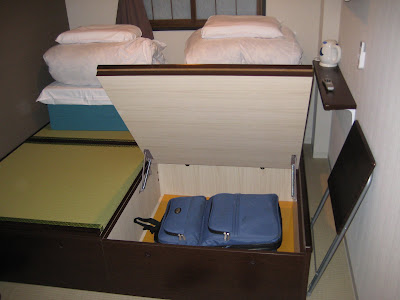
I realize that I didn't really describe the hotel when we first got to Kyoto, so I guess I'll do it now. They advertised themselves as a "Capsule Ryokan." A ryokan is a traditional Japanese accomodation, much like the one we stayed at in Takayama. A capsule hotel... well, you literally stay in a coffin-sized room that is big enough for your bed and a tv mounted on the wall. I think they called it a capsule ryokan because the capsules had tatami floors... which I don't think counts a ryokan, but so be it... in any case, we didn't stay in the capsules - we stayed in the small full rooms that they had. They had a some pretty clever space saving technics: the whole room was pretty much consumed by the double bed, so like a ryokan, the mattresses could be folded up, so that you could have a place to sit/do other things if you wanted to:
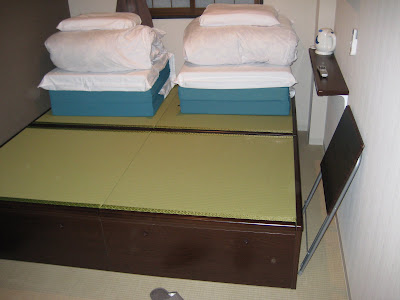

However, unlike a ryokan they didn't actually fold it up/unfold it for you. In fact, they didn't do any room cleaning at all... even though we were there for almost a week... icky. Under the bed part was extra storage

The shower was pretty cool - which was actually the motivation for going with this place in the first place
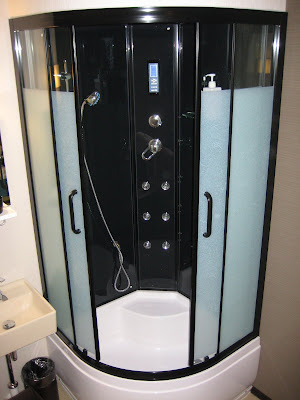

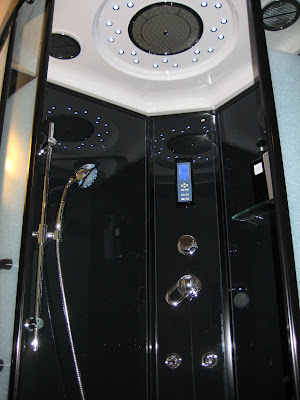
There were three different settings for the water: "Rain" (Which comes from above), regular (which comes from the little hose), and from the side. There were also blue LEDs inside, so you could really feel like you were in a high tech shower.

And finally....the possessed toilet!


In any case, the train ride to Osaka was a short one, so we spent a while just exploring the area. For the record, if I were to live in Japan, I would definitely live in Osaka. It is a big city, but much more laid back than Tokyo. We stayed in the Namba area, which was a pretty bustling place. There were lots of covered shopping streets (like those in Kyoto), tons of arcades, restaurants, and Tower records!


Also, when you go down the backstreets... well I'm not sure how to describe this, but you actually feel like you're in a foreign country. Though Tokyo had a bunch of high tech stuff and Kyoto had a lot of really old Japanese culture, they are really quite international cities. Most people speak at least some English, signs are in both English and Japanese, and they are all very clean and modern. While Osaka has a lot of modern entertainment/shops, when you go down the back streets, there's actually some DIRT and places where no one speaks English! I wish I had gotten some pictures of it...

In any case, Osaka is also famous for its food (particularly takoyaki and okonomiyaki), so after we checked into the hotel, we went out near the waterfront to a food amusement park. There was a really awesome food amusement park quite close to our hotel in the dotombori area (the center of Osaka's food culture), but it was closed, so we were just looking for any place where we could sample Osakan cuisine. The place we settled on was almost entirely empty, and I'm not super sure how it differed from any mall food court except for the decor... but we did try some pretty neat foods.

This one is a rice ball wrapped in some heavily marinated, seemingly spit-roasted, thinly sliced meat. It was amazing.


We also had curry-pan, which is a fried bread filled with curry (the Japanese put a lot of things in bread that we wouldn't even think of... like noodles...??). The curry pan was also pretty good. Failures were: takoyaki (which is sad because they are the ultimate Osaka food), and omurice - or as Erik calls it an "egg burrito." Omurice is rice mixed with catsup and stir fried, then wrapped in a thin omelet-like thing of egg. Different places I saw in Japan put different things on it - everything from more catsup to various curries. I wasn't a big fan because of the catsup... and Erik, who doesn't like egg OR catsup, thought the dish had no redeeming qualities. Oh well...
Afterward we rode a really big ferris wheel that overlooked the bay...


It was very windy and our car rocked alot and made loud noises, so I was scared... fortunately there was a giant Pooh in our cabin:


Erik was mostly interested in getting some cool views of the city:


Admittedly, the view (and pictures) would have been better if it had been daytime, but it was cool to see all the sparkly lights.

April 20

Tuesday being our last full day in Kyoto, we went to see the Fushimi Inari shrine, even though it was a bit rainy outside. I don't know super much about the Shinto religion, but Inari is the god of money/prosperity...


He is/looks like a little fox guy... I think he's really cute... but maybe that's disrespectful to say? Anyway, the only other thing I know about Inari is that his favorite food is Inarizushi. So there you go, you are now as knowledgeable as I am. Since Inari is the god of prosperity, many businesses have built torii for him throughout the years, so that now they're pretty much all just one big tunnel:


Here I think I'm annoyed at Erik for taking so many pictures:


Here's where the torii started to get really dense:


On the backside of the torii, the name of the business who had donated the torii was listed. Erik wanted me to find something recognizable like "Toyota," to no avail.


At many shrines there are little wooden rectangles that you can buy. In theory, if you write your wishes on these little rectangles and hang them at the shrine, they will come true. At the inari shrine, the pieces of wood were shaped like foxes. Everyone seemed to have drawn a fox on the front, and then written their wish on the back. There were some pretty fun drawings:


The shrine was really huge, and while it seemed like the main building was under construction (hence the lack of pictures), there were lots of smaller shrines where people had made offerings. I actually didn't see many inarizushi (maybe because of the rain? My guess is that Inari isn't too fond of soggy inarizushi), but we saw a ton of these little tiny torii placed at the smaller shrines.


Ooh, and the best part?? There were lots of kitties!!!


This black kitty liked me and rubbed up against my pant leg, but Erik wouldn't let me pet it because it may have been diseased. Whatever.


After the Inari shrine, we planned to spend the rest of the day checking out some cool old shops from the book Old Kyoto by Diane Durston (I highly recommend this book if you're ever going to Kyoto)... but first.... MONSTER PARFAIT!!!!


The top part was yummy with the strawberries and waffles, but it got less good as we progressed. Mostly whipped cream and jello. Maybe they didn't actually expect people to get that far down? But we're American, dang it! We finished the whole thing.

The old shops that we visited next have been in business for hundreds of years (like 1600s), which would of course be unheard of in America. It appears that I didn't actually get many pictures of the shops... so I won't bore you with too many details. Suffice it to say that we went to this really amazing shop that sold all sorts of paper products, calligraphy tools, incense, tea ceremony tools, etc... it was called Kyu Kyo Do according to my shopping bag. We also went to this shop called Bunnosuke-jaya. Apparently this is one of the few remaining places in Kyoto (perhaps the only remaining place) that sells Amazake, a non-alcoholic beverage made from sake lees.


It's the cup there next to my water glass. It's kind of hard to describe, but it was very thick (hence the glass of water... I needed a beverage to wash down my beverage), and was not super sweet, but I guess had sort of a natural sweetness to it? The owner of the shop explained to us that it didn't have anything added at all, it was just made from rice. I don't know that I LOVED the drink, but it was interesting, and I probably won't ever have another opportunity to drink it.
Thoroughly hydrated, we attempted to rush across town to visit the Kyoto International Manga Museum before it closed. I think we got there with about 45 minutes to spare.


There was a lot to see, and we only saw a fraction of it, but I would love to spend a whole rainy day in there. They had an exhibit about the history of manga and its spread worldwide, as well as many exhibits about the production of manga, drawings by many famous mangakas (people who write/draw manga), and some avante garde manga stuff. Erik and I mostly checked out the history of manga section... which pretty much made us want to read a whole bunch of manga. This is apparently a common response, as the museum has a whole huge library of manga in various languages that you can just sit in there and read. Unfortunately, we ran out of time and have to leave with our mangappetites unsatiated, left to later consume what is accessible in the United States.